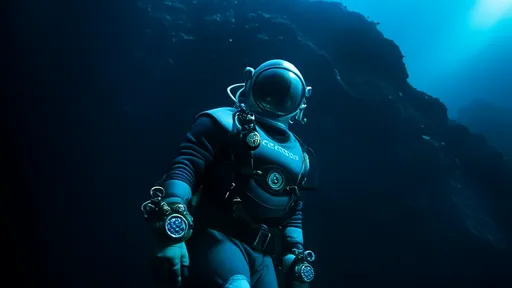
The world beneath the ocean's surface has always fascinated humanity, yet its depths remain one of the least explored frontiers. For those who venture into the abyss—whether divers, submariners, or researchers—the crushing pressures of the deep present a formidable challenge. The human body, evolved for life at sea level, must undergo remarkable physiological adaptations to survive in these extreme conditions. Understanding how deep-sea workers cope with high-pressure environments is not just a scientific curiosity; it’s a matter of life and death for those who make their living in the ocean’s unforgiving embrace.
The Crushing Weight of the Deep
Descending into the ocean’s depths, pressure increases by approximately one atmosphere every 10 meters. At 100 meters, the pressure is already ten times greater than at the surface—enough to collapse unprotected lungs and compress air-filled spaces in the body. For commercial divers working on oil rigs or underwater construction, or scientists conducting prolonged deep-sea research, exposure to these pressures requires careful preparation and gradual acclimatization. The body’s response to this environment is a complex interplay of biological adjustments, some immediate, others developing over weeks or months of exposure.
Immediate physiological responses to deep diving include the compression of gases in the lungs and other body cavities. As external pressure mounts, nitrogen—a gas inert at surface levels—begins to exert narcotic effects, leading to the phenomenon known as nitrogen narcosis. This can impair judgment and motor skills, posing serious risks to divers. Oxygen, too, becomes toxic under high pressure, requiring precise mixture in breathing gases to avoid seizures or lung damage. The body’s initial reaction is one of stress: heart rate variability changes, blood vessels constrict, and the nervous system enters a state of heightened alert.
The Slow March of Adaptation
For those who make repeated deep dives or live in pressurized environments for extended periods, the body begins to adapt in more sustained ways. One of the most critical adaptations involves the way gases dissolve in the bloodstream. Under high pressure, gases like helium (often used in deep-diving mixtures) permeate tissues more thoroughly, requiring meticulous decompression schedules to avoid the formation of deadly bubbles during ascent—the cause of decompression sickness or "the bends." Over time, frequent divers develop what’s known as "isobaric counterdiffusion," where their bodies become more efficient at managing gas exchange under pressure.
Another fascinating adaptation occurs in the cardiovascular system. Studies of saturation divers—those who live in pressurized chambers for weeks—show that their blood volume increases, and their hearts undergo subtle remodeling to cope with the increased workload of pumping blood in a high-pressure environment. The kidneys play a crucial role in this process, adjusting fluid balance and electrolyte levels to maintain homeostasis. Even the lungs change, with some evidence suggesting that long-term divers develop slightly altered lung capacity and more efficient gas exchange mechanisms.
The Hidden Toll on the Body
Despite these adaptations, the deep takes its toll. Bone necrosis, hearing loss, and chronic joint pain are well-documented among career divers. The high-pressure nervous syndrome (HPNS), characterized by tremors, dizziness, and cognitive impairment, remains a risk for those venturing below 150 meters. Perhaps most concerning are the long-term neurological effects; some studies suggest that repeated exposure to high pressure may lead to subtle but cumulative brain changes, though research in this area remains ongoing.
Modern technology has developed various ways to mitigate these risks. Saturation diving systems allow workers to live at pressure for weeks, only decompressing once at the end of their work period. Exosuits and atmospheric diving systems maintain surface pressure around the diver, eliminating many physiological concerns—though these come with their own limitations in mobility and cost. Meanwhile, researchers continue to explore pharmacological interventions that might one day help divers better tolerate pressure extremes.
The Future of High-Pressure Physiology
As humanity’s ventures into the deep sea expand—whether for resource extraction, scientific research, or even deep-sea tourism—understanding high-pressure physiology becomes increasingly vital. New discoveries in this field could revolutionize not just diving medicine but also treatments for conditions like stroke or traumatic brain injury, where pressure plays a role in tissue damage. The brave individuals who work in the ocean’s depths serve as both pioneers and test subjects in this challenging environment, their bodies charting the limits of human adaptability.
The study of deep-sea workers’ physiology stands at the intersection of human ambition and biological limitation. Each dive pushes the boundaries of what we know about the human body’s capacity to adapt. As we continue to explore this final frontier on Earth, the lessons learned from those who work under pressure will illuminate not just the mysteries of the deep, but the remarkable plasticity of human biology itself.
By /Jul 21, 2025

By /Jul 21, 2025

By /Jul 21, 2025
By /Jul 21, 2025
By /Jul 21, 2025

By /Jul 21, 2025

By /Jul 21, 2025

By /Jul 21, 2025

By /Jul 21, 2025

By /Jul 21, 2025

By /Jul 21, 2025

By /Jul 21, 2025

By /Jul 21, 2025

By /Jul 21, 2025

By /Jul 21, 2025

By /Jul 21, 2025
By /Jul 21, 2025

By /Jul 21, 2025

By /Jul 21, 2025

By /Jul 21, 2025